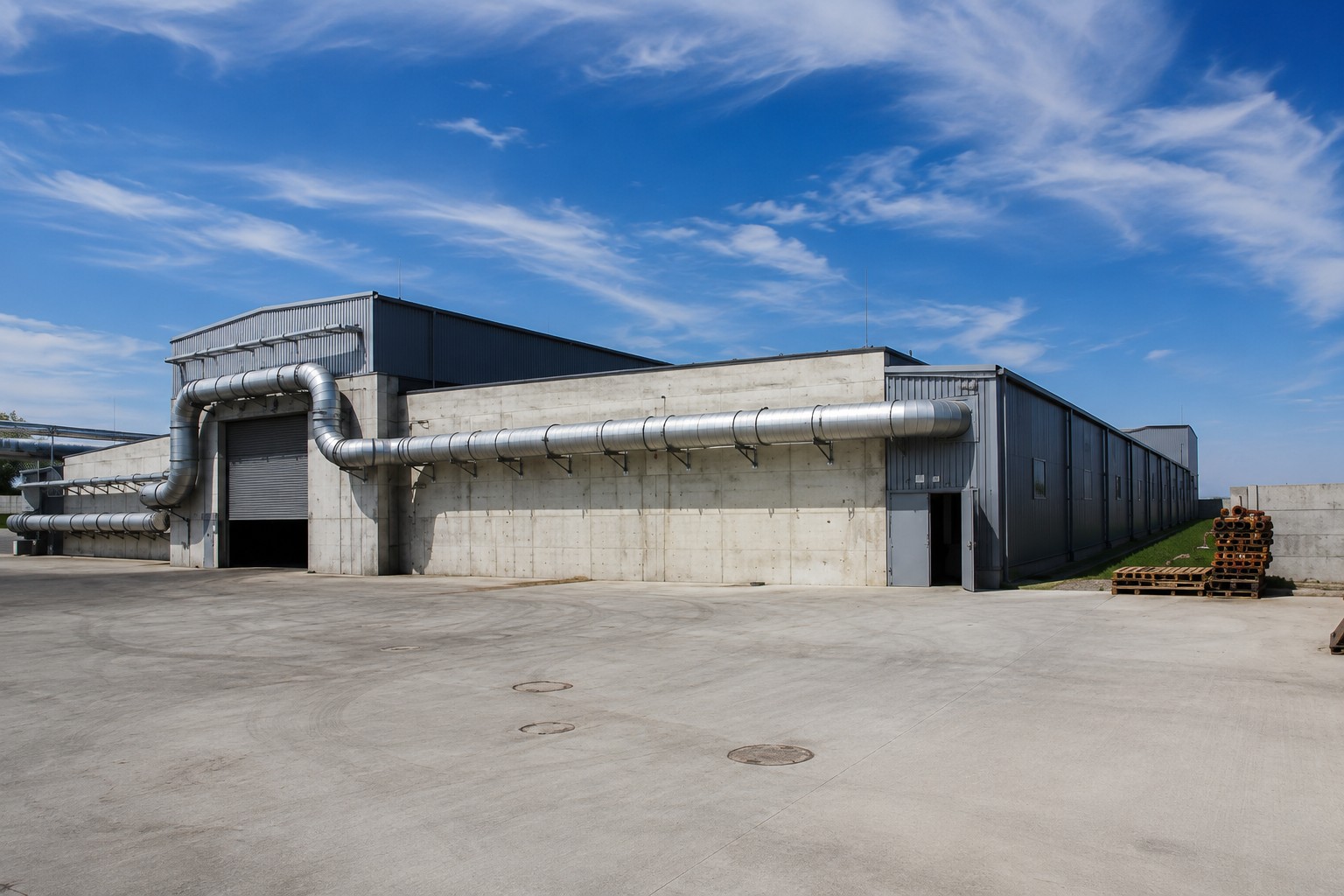
The growing demands of the circular economy and ever-higher levels of raw material recovery present operators of mechanical-biological waste treatment (MBT) facilities with a difficult challenge. Many facilities are reaching their capacity limits without the budget or space for new facilities, while regulatory pressure and rising landfill costs make it impossible to simply postpone the decision to increase capacity. In this situation, modernizing the MBP facility—with a focus on the biological section—allows operators to regain the missing capacity without expanding the entire plant and, in many cases, without interrupting its daily operations.
Modernization of the MBP plant—why does the biological section determine the plant’s efficiency?
The bottleneck in an MBP facility is usually not the sorting plant, but the biological section of the municipal treatment plant —the aerobic stabilization or composting stage for the undersize fraction. Sorting takes hours, while biological treatment takes weeks; that is why this stage determines the facility’s actual annual throughput, even if the sorting plant operates flawlessly.
In practice, this means that the limiting factor is not the processing capacity of the screen or separator, but the number of cycles that the bioreactor or composting tunnel can perform in a year. If the duration of a single cycle is, for example, several weeks, and the surface area of the bioreactors is fixed, then the only way to increase annual throughput—without building additional modules—is to shorten the cycle or improve its stability, thereby reducing the number of repetitions and downtimes resulting from incomplete stabilization of the material.
How can you increase the efficiency of the composting process without increasing the volume?
Increasing the efficiency of the biological stage does not require the construction of new bioreactors—in most cases, technological optimization of the existing infrastructure is sufficient. In practice, this boils down to three areas: aeration and process control, feedstock preparation, and control automation.
Modernization of aeration and process control systems
The reduction in aerobic stabilization time is achieved primarily through the modernization of aeration systems and the implementation of intensive aeration of the material. NOVA-KOMP technology, based on the precise injection and extraction of post-process air, maintains optimal aerobic conditions in the windrow, which shortens the cycle and increases the throughput of the composting tunnel. Maintaining a slight negative pressure in the process chambers is also crucial here—it limits uncontrolled odor emissions while forcing uniform air movement throughout the entire volume of material, thereby eliminating anaerobic zones that prolong stabilization time and reduce the quality of the final product.
Substrate Engineering and Optimal Material Preparation
The process rate also depends on the preparation of the feedstock—compacted, unevenly moistened organic material restricts airflow, prolongs stabilization, and increases odor emissions. Traditional mixing with a loader, despite its low cost, creates compacted pockets of material and uneven moisture content, which reduces the efficiency of the entire system in the long run. Replacing it with intensive, non-compressive mixing and proper selection of the feed structure allows for a homogeneous, well-aerated mass without the need to increase the process area.
Automation and Computer Control
Manual control of fans and irrigation carries the risk of operator errors and inconsistent process control across individual compost piles or bioreactors. Implementing a system for continuous monitoring of temperature, humidity, and oxygen levels, combined with automatic fan control, allows for real-time responses to changes in parameters, rather than waiting for a visual inspection by the operator. The data collected by such a system also serves a documentation purpose—it facilitates demonstrating the process’s compliance with regulatory requirements and allows deviations to be detected early, before they result in a longer cycle time or a decline in the quality of the stabilized product.
The most common limitations on the performance of the biological section in existing MBP facilities:
- outdated or insufficiently efficient aeration systems,
- lack of control over process parameters (temperature, humidity, oxygen),
- uneven preparation and mixing of the batch,
- manual, uncoordinated control of the fans,
- insufficient biofiltration efficiency and problems with the disposal of the stabilized sludge, resulting from the quality of the final product of the process.
Modernization of the MBP System and Current Environmental Requirements
MBP facilities must comply with the requirements of the regulation governing mechanical-biological waste treatment, including parameters regarding the quality of the stabilized material and emission limits. Growing requirements regarding recovery and recycling rates—and, in the future, the impact of the deposit-return system on the waste stream entering municipal facilities—mean that the biological component designed over a dozen years ago is often no longer capable of effectively handling the changed composition of waste. Modernization allows the process to be adapted to current regulatory requirements without the need to build a new facility or repeat the entire investment process from scratch.
The Economic Aspect of the Changes: The Cost of Modernization vs. Building a New Facility
Expanding a waste treatment facility with a new building or additional bioreactors requires significant capital investment and usually involves a new environmental permitting process, which significantly lengthens the entire implementation process. Modernizing the biological section allows for a similar result to be achieved much more quickly—usually within a few weeks or months—using the existing infrastructure and at significantly lower investment costs. In many cases, it is also possible to carry out the work without having to obtain a new environmental permit, although each investment requires an individual legal and regulatory analysis.
An additional advantage of modernization is the ability to carry out the work in phases. Individual sections of the facility can be modernized one after another, allowing the plant to maintain continuous operation and avoid having to completely suspend waste reception and processing. In the case of constructing a new facility, coordinating the project with ongoing operations is much more complex and time-consuming.
Modernization primarily allows for an increase in the throughput of the existing biological treatment section by streamlining the process and making better use of the available volume. The construction of a new facility, on the other hand, provides the opportunity to achieve a larger process area and higher treatment capacity, but it involves much greater financial outlays, a longer construction period, and more complex administrative procedures.
Shorter implementation time means faster business results: increased throughput of the MBP system while optimizing the plant’s operating costs—lower energy consumption and fewer service interventions. Importantly, phasing the modernization work allows for spreading the costs over time and carrying out the work section by section, without halting waste acceptance across the entire plant.
How does the process of modernizing the MBP system work in practice?
The modernization process usually begins with a technological audit of the existing facility, during which the operating parameters of the bioreactors, the condition of the aeration systems, and the methods of material preparation and handling are analyzed. Based on this, a technical and technological concept is developed, identifying which elements of the process can be modernized without changing the facility’s volume and which would require expansion. The next stage is the detailed design, which includes the selection of specific equipment—fans, control systems, and, if necessary, mixers—as well as, if required, determining the scope of environmental permitting procedures. The final stage is implementation and commissioning, during which the new solutions are put into operation gradually, and the plant staff undergoes training on how to operate the modernized systems, which helps avoid typical operational errors during the initial period of operation following the modernization.
Modernization of the MBP system with AK NOVA – an experience that delivers results
AK NOVA Sp. z o.o. is a Polish engineering firm that has been operating in the waste management sector since 2003, managing the entire investment process in-house—from concept, through design and permitting, to construction and commissioning of the facility. Thanks to its proprietaryNOVA-KOMP technology, implemented in over twenty facilities in Poland, the AK NOVA team assesses the actual potential of an existing plant and proposes solutions tailored to its specific technological and locational characteristics. The company carries out modernization and construction projects in collaboration with the largest players in Poland’s waste management industry, which translates into practical experience working with various systems and generations of mechanical biological treatment (MBT) facilities.
It’s a good idea to start the modernization of the biological section with a technological audit that precisely identifies what is limiting the current throughput, rather than investing in solutions chosen intuitively, without analyzing the actual bottleneck in the process. We invite you to contact the AK NOVA team to discuss the possibilities for modernizing your existing system.
Frequently Asked Questions About MBP System Upgrades
Does the modernization of the biological section require a new environmental decision?
It depends on the scope of the changes—renovations within the existing building envelope generally do not require a new permit, but each case requires a separate formal and legal analysis.
How long will the modernization of the MBP system take?
Usually anywhere from a few weeks to a few months, depending on the scope of the work—much shorter than building a new structure.
Will the modernization increase capacity without building new facilities?
Yes. Improved aeration, substrate preparation, and automated control shorten the process time, increasing the number of cycles processed in the same volume.
Can the modernization be carried out without shutting down the entire system?
In most cases, yes—the work is carried out in phases, section by section, allowing the facility to continue accepting and processing waste while the changes are being implemented.
What are the first signs that the biological component of the system needs to be upgraded?
The most common issues are: longer stabilization times, problems with the quality of the stabilized material, an increasing number of odor complaints, and a decrease in actual annual throughput compared to the plant’s designed capacity.